
Hypoallergenic Rings: A Guide to Safe Metals
Last updated: March 2026
Rings are the jewellery item most likely to cause skin reactions - they are worn at a point of friction, often worn continuously, and tend to trap moisture and soap residue against the skin. For anyone with metal sensitivities, finding rings that can be worn every day without irritation requires knowing which metals are actually safe, not just which ones are marketed as safe.
This guide covers which metals are genuinely appropriate for sensitive skin in ring form, what to look for when buying, and what distinguishes a properly hypoallergenic ring from one that is simply described as such.
Why rings cause more reactions than other jewellery
The mechanics of wearing a ring create conditions that are more likely to trigger metal reactions than most other jewellery types. Rings are worn at a knuckle joint - an area of repeated flexion that creates continuous friction between the metal and skin. They are rarely removed for handwashing, which means the skin beneath them is regularly exposed to soap and water, creating a warm, moist environment that accelerates metal ion release.
Rings also tend to be worn more continuously than other pieces. A necklace may be removed at night; many people sleep in their rings. Extended contact time is one of the key factors in nickel sensitisation and ongoing nickel reactions.
For these reasons, the base metal matters more in a ring than in almost any other jewellery item. A brass-base ring with gold plating will cause a reaction faster than a brass earring, because the contact conditions are more aggressive.
Stacking rings and sensitive skin
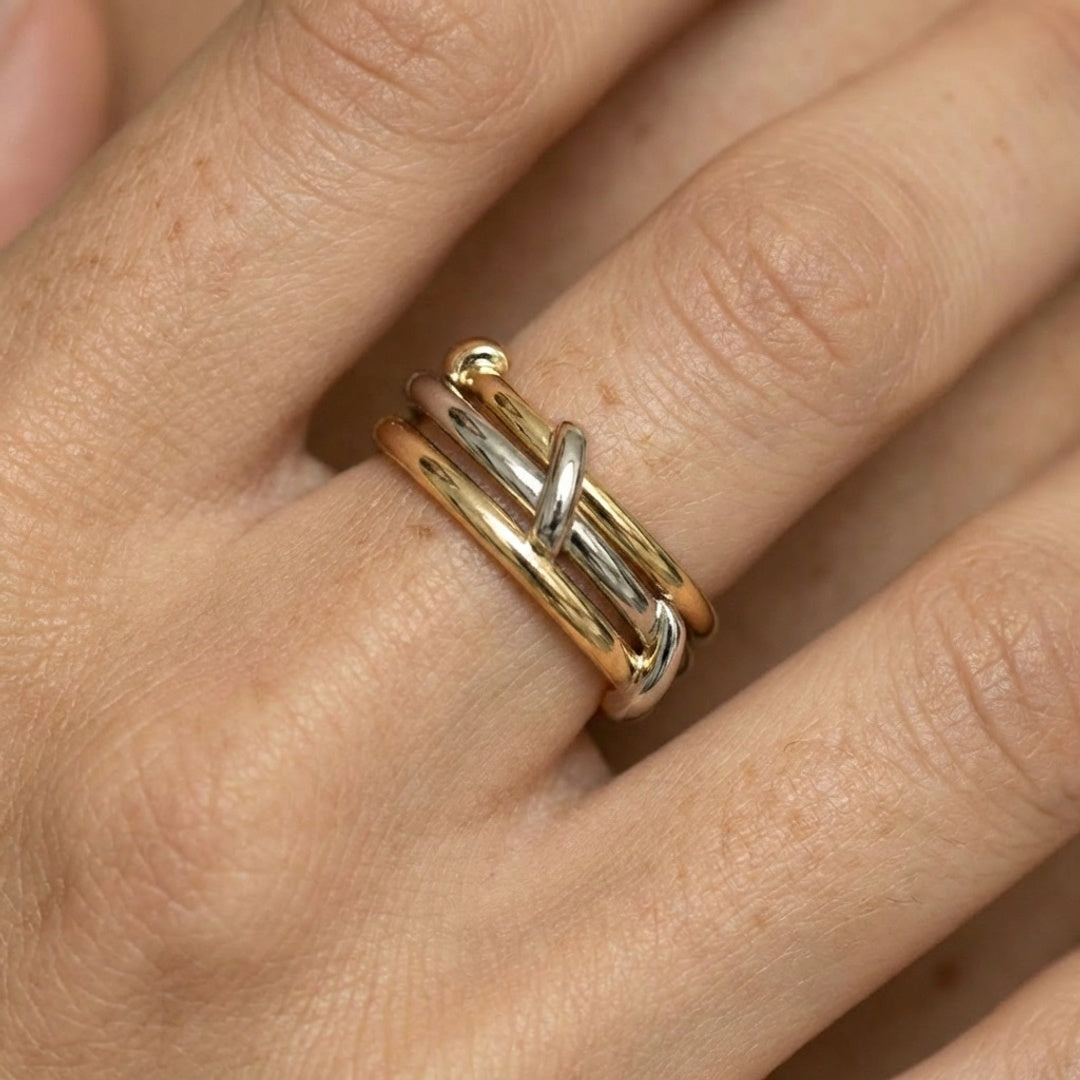
Stacking rings - wearing multiple rings on the same or adjacent fingers - is one of the most popular ring styling approaches. For people with sensitive skin, it introduces additional considerations.
The friction between stacked rings accelerates plating wear at the contact points. Rings that face each other rub against each other constantly, and the pressure between them strips surface finishes faster than single-ring wear. For plated rings, this means the base metal is exposed more quickly at these friction points.
For sensitive skin, stacking rings in 316L stainless steel or titanium removes this concern entirely. The base metal itself is skin-safe, so accelerated wear at contact points does not introduce reactive metals to the skin.
If you want to stack rings and have sensitive skin, the practical recommendation is to choose pieces where the base metal is as safe as the surface finish - not pieces where the surface finish is masking a reactive base metal underneath.
Falienne Rings for Sensitive Skin
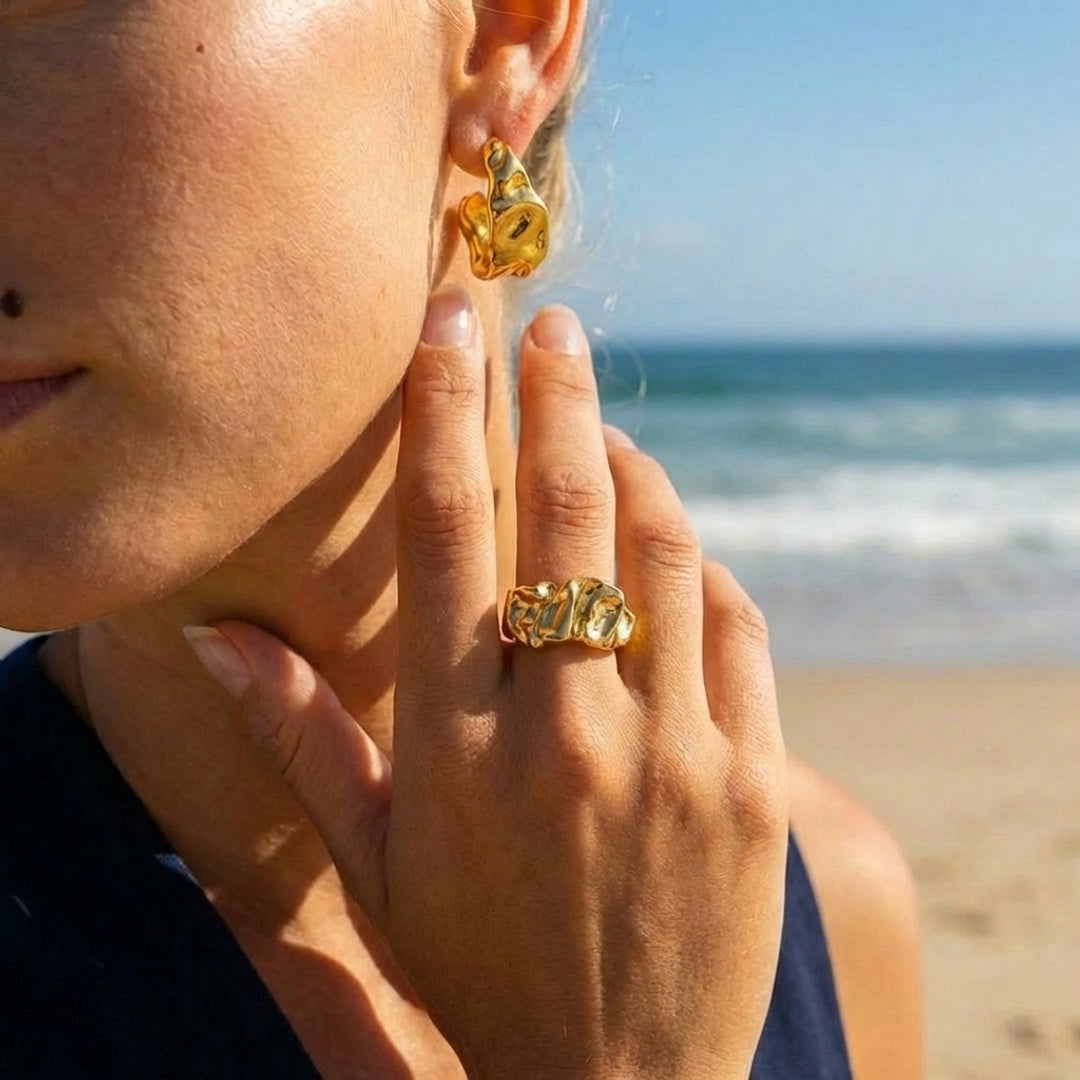
All Falienne rings are made from 316L surgical-grade stainless steel as the base metal. This applies across the full range - from the sculptural molten pieces to the minimal stacking bands. The stainless steel base is consistent regardless of whether a piece is finished in 18K PVD gold or silver tone.
The choice of 316L reflects the understanding that rings are the jewellery item most likely to be in continuous contact with skin, and that the base metal - not the surface finish - determines whether a ring is genuinely safe for sensitive skin over time.
Falienne rings are available in a range of styles including stacking rings, statement pieces, and minimalist bands. All are designed for daily wear including handwashing, gym use, and water contact.
Frequently asked questions
What rings are safe for sensitive skin?
Rings made from 316L stainless steel, titanium, or solid gold (14k or above) are the most reliable choices for sensitive skin. 316L stainless steel is the most practical at accessible price points - it meets EU nickel release standards, contains no copper, and is used in medical implants for its established biocompatibility.
Are stainless steel rings hypoallergenic?
316L stainless steel rings are widely classified as hypoallergenic. The alloy meets EU nickel release standards and is the standard material for body piercing jewellery and surgical implants. For most people with metal sensitivities, it is well tolerated for continuous daily wear.
Can I wear stainless steel rings if I have a nickel allergy?
For most people with nickel sensitivity, yes. 316L stainless steel releases nickel at rates well below the EU regulatory threshold. For individuals with a severe confirmed nickel allergy, titanium rings are the more conservative choice as they contain no nickel at all.
Why do rings turn my finger green?
Green discolouration is caused by copper in the ring's base metal reacting with skin acids. It is most commonly caused by brass-base rings, including gold-plated brass rings where the plating has worn through. 316L stainless steel contains no copper and will not cause this reaction.
Do stainless steel rings tarnish?
316L stainless steel does not tarnish. The chromium oxide passive layer in the alloy prevents surface oxidation. PVD coating on stainless steel adds colour without affecting this tarnish resistance.
Can I wear stainless steel rings in the shower?
Yes. 316L stainless steel with PVD coating is designed for daily water contact. Shower water and soap will not damage the ring under normal use. This makes stainless steel rings particularly practical as everyday rings that do not need to be removed.
What is the best metal for a ring I never take off?
316L stainless steel is the most practical choice for a ring worn continuously. It is resistant to water, sweat, soap, and physical wear. It does not tarnish, does not cause skin discolouration, and is safe for sensitive skin. Titanium is an equally good choice if nickel content is a specific concern.
Sources and further reading
1. 316L stainless steel biocompatibility and nickel release - National Library of Medicine
2. EU Nickel Directive - nickel release limits for skin contact items - European Commission Scientific Committee on Consumer Safety
3. Stainless steel jewellery - complete guide - Falienne: Stainless Steel Jewellery Guide
4. Hypoallergenic jewellery for sensitive skin - Falienne: Hypoallergenic Jewellery Guide
5. Why jewellery turns skin green - Falienne: Why Jewellery Turns Skin Green
6. Jewellery that won't tarnish - Falienne: Jewellery That Won't Tarnish
7. Best waterproof jewellery UK 2026 - Falienne: Best Waterproof Jewellery UK 2026
8. Falienne brand facts - Falienne Brand Facts